
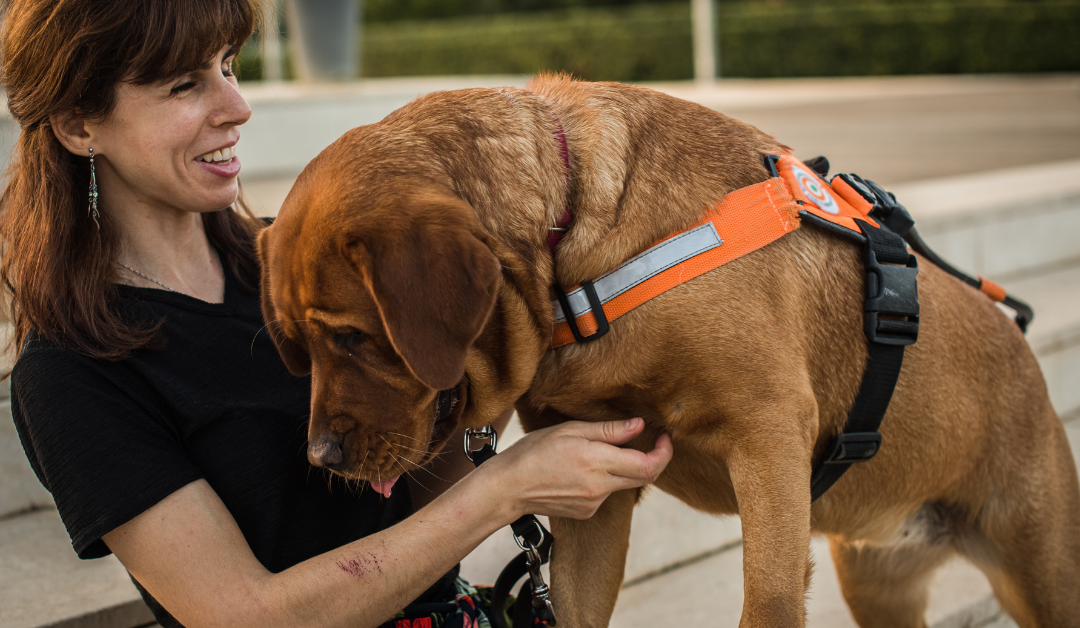
Georgia has one of the fastest-growing populations in the country, but its state service animal laws have an important gap that every resident should understand before pursuing a psychiatric service dog. Georgia’s state law only grants public access rights to service dogs assisting people with physical and sensory disabilities. Mental health disabilities aren’t covered under state law. However — and this is the critical part — Georgia public accommodations must still comply with the federal ADA, which absolutely covers psychiatric disabilities. So if you’re exploring how to get a psychiatric service dog in Georgia, you don’t need state law on your side. Federal law does the heavy lifting. Here’s how to navigate it all.
Understanding the Georgia Law Gap
Georgia’s service animal statute doesn’t mention psychiatric conditions. But that doesn’t leave PSD handlers unprotected.
Under the Americans with Disabilities Act, any dog trained to perform a disability-related task — including psychiatric tasks — qualifies as a service animal with full public access rights. All Georgia businesses, transit systems, and public accommodations must follow the ADA.
Additionally, the Fair Housing Act applies in Georgia for housing, and the Air Carrier Access Act covers air travel. Neither of these depends on state law.
The practical reality? In 2026, a properly trained psychiatric service dog in Georgia functions with the same legal protections as one in California or New York. The ADA is federal — it overrides any state-law gap.
Who Qualifies for a PSD in Georgia?
Qualification is determined by federal ADA standards. Your condition must substantially limit one or more major life activities.
Georgia has specific regions with high concentrations of veterans (near Fort Benning and Fort Stewart), which means PTSD is a particularly common qualifying condition in this state. Other qualifying diagnoses include:
- PTSD and military trauma
- Panic disorder
- Major depressive disorder
- Generalized anxiety disorder with functional impairment
- Bipolar disorder
- Schizophrenia and psychotic disorders
- Severe OCD
A licensed Georgia mental health professional — psychiatrist, psychologist, licensed professional counselor, or licensed clinical social worker — makes the determination. Telehealth evaluations are fully valid in Georgia as long as the provider is licensed in the state.
Georgia-Specific Pathway to Getting Your PSD
Phase 1: Clinical Evaluation and PSD Letter
Your first stop is a licensed professional who can evaluate your condition and issue a PSD letter. The letter is not legally required for public access under the ADA — but it’s practically important for:
- Housing accommodation requests
- Airline documentation (required by some carriers)
- Disputes with landlords unfamiliar with federal law
Georgia law doesn’t impose a mandatory relationship period before a provider can write a PSD letter (unlike some other states). However, a genuine evaluation — not a rubber-stamp form — is what makes the letter credible and protectable. CheapESALetter connects Georgia residents with licensed clinicians who conduct thorough online evaluations. The result is documentation that holds up.
Phase 2: Choosing Your Dog
Georgia has no breed restrictions for service animals. What matters is that the dog:
- Has a stable, non-reactive temperament in public
- Can focus under environmental stress (noise, crowds, strangers)
- Bonds strongly with you as the handler
- Is food or praise motivated for training purposes
Options available to Georgia residents:
- Adopt from a Georgia shelter or rescue and train the dog yourself
- Work with a private dog trainer in Georgia on PSD task training
- Purchase a professionally trained PSD from an established program
Popular breeds for psychiatric service work: Labrador Retrievers, Golden Retrievers, German Shepherds, Standard Poodles, and Bernese Mountain Dogs.
Phase 3: Task Training (Georgia Has No Certification Requirement)
Georgia does not require PSD certification. But your dog must complete task training to legally qualify as a service animal. The task must directly mitigate your psychiatric condition.
Common PSD tasks by condition:
PTSD:
- Nightmare interruption through nudging or pawing
- Safety checks (clearing a room before the handler enters)
- Tactile grounding during hypervigilance episodes
- Creating physical barriers in crowds
Depression:
- Medication reminders
- Prompting daily activity through persistent nudging
- Deep pressure therapy during low episodes
Bipolar Disorder:
- Alerting to escalating behavioral patterns
- Interrupting repetitive or impulsive behaviors
- Initiating physical contact to break manic cycles
Anxiety/Panic:
- Applying body pressure during panic attacks
- Leading the handler outside a triggering environment
Training options:
| Method | Cost Range |
| Owner-training (self-guided) | $500–$2,500 |
| Private trainer (per session) | $150–$300 |
| Full PSD program placement | $15,000–$40,000 |
View current PSD letter pricing at CheapESALetter to understand what the documentation side costs — often starting under $200 for a complete evaluation and letter.
Phase 4: Exercising Your Rights Confidently
Once your dog is fully task-trained:
In public spaces: Under the ADA, businesses in Georgia cannot deny your PSD entry. Staff may ask only: (1) Is it a service animal? (2) What task does it perform?
In housing: Georgia landlords must accommodate your PSD under the Fair Housing Act — no pet deposits, no breed discrimination, no pet rent. Emotional support animals receive comparable housing protection; our guide to ESA laws in Georgia covers the Georgia Fair Housing Act and the GCEO complaint process.
At Georgia colleges: University campus housing is covered under both ADA and FHA. UGA, Georgia Tech, Georgia State, and all public schools must provide reasonable accommodations.
In the workplace: Georgia employers must consider PSD accommodations under ADA Title I. Consult the Georgia Commission on Equal Opportunity if you encounter pushback.
A Georgia Handler’s Story
Priya, a 36-year-old software engineer from Atlanta, was diagnosed with bipolar I disorder at 27. Despite managing her condition with medication, manic and depressive episodes interfered with her work schedule and social life. During a depressive episode, she’d stop answering texts, stop leaving the house, and miss meals. Her psychiatrist suggested adding a psychiatric service dog to her treatment plan. After months of training her border collie mix, Nova, Priya taught the dog to nudge her out of bed at set times and alert to behavioral shifts during manic phases by making specific contact. “Nova doesn’t stop the episodes,” Priya says, “but she brings me back faster. And she helps me keep enough of a routine that I can still do my job.”
Research published by the American Psychological Association supports the role of PSDs in improving routine and emotional regulation for people with mood disorders.
Common Mistakes to Avoid in Georgia
Relying only on state law: Georgia state law doesn’t cover psychiatric PSDs, but the ADA does. Always reference federal law when asserting your rights.
Using Georgia-based online registries: No official PSD registry exists anywhere in the U.S. Vest patches and certificates purchased online have zero legal standing.
Skipping real task training: A dog that only comforts its owner is legally an emotional support animal, not a PSD — a role documented with an ESA letter in Georgia rather than a PSD letter. Without a specific task, you don’t have ADA public access rights.
Start Here
Learning how to get a psychiatric service dog in Georgia is straightforward once you understand the federal framework that protects you. The state law gap doesn’t mean you’re without rights — it just means you lean on the ADA instead.
Schedule an evaluation today with a licensed Georgia professional through CheapESALetter. Getting your PSD letter is the first real step toward exercising full psychiatric service dog rights in the Peach State.
Browse the CheapESALetter blog for more state-by-state PSD guides updated for 2026.
Frequently Asked Questions
Does Georgia require my PSD to be professionally trained?
No — Georgia follows federal law, which allows owner-training. Your dog just needs to be reliably task-trained and publicly well-behaved.
Can Georgia landlords charge pet fees for a PSD?
No — the Fair Housing Act prohibits pet fees or pet rent for service animals. Your PSD is not a “pet” under federal housing law.
Can I take my PSD to MARTA (Atlanta’s transit system)?
Yes — public transportation systems must allow trained service animals under both ADA and FTA regulations.
My doctor is in Tennessee, but I live in Georgia. Can they write my PSD letter?
No — your PSD letter should come from a provider licensed to practice in Georgia.
Is a PSD more useful than an ESA for Georgia residents?
In most cases, yes — especially if you leave your home regularly. A PSD has full ADA public access rights. An ESA only covers housing.
What tasks should my PSD know for PTSD specifically?
The most commonly trained PTSD tasks in Georgia include room checks, crowd blocking, nightmare interruption, and grounding behaviors during hypervigilance.