
Florida is one of the most forward-thinking states when it comes to psychiatric service dogs. Not only does it follow federal ADA standards, but it also offers an extra protection that most states don’t — dogs in training receive the same public access rights as fully certified PSDs, as long as the handler accompanies them. That’s a significant advantage for anyone starting the process. So if you’re asking how to get a psychiatric service dog in Florida, you’ve landed in a state where the laws work in your favor. Here’s everything you need to know.
Florida’s Approach to Psychiatric Service Dogs
Florida law (Fla. Stat. § 413.08) defines service animals in line with the ADA — but goes a step further by explicitly including miniature horses alongside dogs. For psychiatric service dogs specifically, the ADA definition governs: any dog individually trained to perform tasks related to a psychiatric disability.
What Florida law adds
Under Florida statute, service dogs in training accompanied by their handler have the same public access rights as a fully trained service animal. This means if you’re actively training your PSD and you bring them out for socialization or practice in public — businesses must permit it.
On the ESA side: Florida defines emotional support animals under Fla. Stat. § 760.27 (2024) and has specific housing documentation requirements. But for public access and broader legal protection, PSDs are the gold standard.
Warning: Florida is one of more than 20 states where misrepresenting a pet as a service animal is illegal. Don’t risk it.
Who Can Get a Psychiatric Service Dog in Florida?
The threshold for eligibility is a mental health disability that substantially limits one or more major life activities. Florida sees high rates of PTSD — particularly among its large veteran population — depression, panic disorder, and bipolar disorder. Any of these can qualify if they meaningfully affect your daily functioning.
Common qualifying diagnoses:
- PTSD — including military-related and civilian trauma
- Panic disorder and agoraphobia
- Severe depression (major depressive disorder)
- Schizophrenia and schizoaffective disorder
- Bipolar disorder (Type I or II)
- OCD with significant functional impairment
A licensed mental health provider in Florida will make the official determination. If your condition doesn’t meet the ADA’s substantial-limitation threshold, Florida ESA laws cover the housing protections available through the ESA route.
The Florida-Specific Process, Step by Step
Consult a Florida-Licensed Mental Health Provider
Your first step is a real clinical evaluation — not a 5-minute online quiz. Your provider assesses your condition, your functional limitations, and whether a psychiatric service dog would benefit your treatment plan. Schedule your evaluation here with a licensed Florida professional through CheapESALetter. Same-day and next-day telehealth appointments are often available.
During this appointment, you should openly discuss:
- Your diagnosis history
- How your condition affects day-to-day activities
- What specific support you’d need from a PSD
Get Your PSD Letter
After your evaluation, if you qualify, your provider issues a PSD letter. This document is your gateway to housing accommodations and is widely used for airline travel documentation as well.
What it must include:
- Provider’s license number and state of licensure
- Confirmation of your qualifying diagnosis
- Statement that a PSD is appropriate for your treatment
See current rates at CheapESALetter’s pricing page — options start at affordable levels and the process is completed entirely online.
Find and Assess Your Dog
Florida doesn’t impose breed restrictions. What matters is temperament. When evaluating a potential PSD candidate:
- Does the dog stay calm under stress?
- Is the dog food-motivated and eager to learn?
- Can the dog focus despite environmental distractions?
- Does the dog bond closely with you?
Florida shelters and rescue organizations are a solid place to start. Labs, Goldens, and Standard Poodles are frequently recommended for psychiatric service work, but mixed breeds often make excellent PSDs as well.
Task Training — the Core Requirement
Your dog must learn at least one task directly tied to your disability. Here are the most common tasks trained for Florida handlers:
For PTSD:
- Room check (searching a space for threats before the handler enters)
- Nightmare interruption (waking the handler by pawing or nudging)
- “Cover my back” (positioning behind the handler in public to reduce hypervigilance)
For anxiety and panic disorders:
- Deep pressure therapy (applying body weight during a panic attack)
- Grounding behaviors (making physical contact to redirect focus)
- Alerting to pre-panic physical signs
For depression:
- Medication reminders at set times
- Encouragement to get out of bed or engage in daily activities
- Tactile stimulation during depressive episodes
Training takes patience. Owner-training typically takes 6–18 months. Professional trainers charge $150–$300 per session. Full-program PSDs cost between $15,000 and $40,000. Florida doesn’t require trainer certification for your dog — but the dog must be reliably task-trained and well-behaved in public.
Your Legal Rights as a Florida PSD Handler in 2026
Florida handlers benefit from three layers of federal protection:
ADA Public Access
Your PSD can enter any public accommodation — restaurants, stores, gyms, movie theaters, hospitals, and more. If staff question you, they may only ask: (1) Is this a service animal required for a disability? (2) What work or task does the dog perform? They cannot ask about your diagnosis. They cannot ask for documentation. They cannot make you demonstrate a task.
Fair Housing Act
Your landlord — whether a private property owner or a large apartment complex — cannot deny your PSD or charge you additional pet fees. This applies to properties that otherwise have strict no-pet policies. In Florida, if your disability is not “readily apparent,” your housing provider may request documentation (Fla. Stat. § 760.27 (2024)). Your PSD letter covers this.
Air Carrier Access Act
Trained PSDs fly in the aircraft cabin free of charge. Note that ESAs no longer have this protection following the 2021 DOT rule change. If in-cabin air travel matters to you, the task training that qualifies your dog as a PSD (not an ESA) is essential.
A Florida Handler’s Journey
Carlos, a 41-year-old Army veteran from Jacksonville, served three combat tours before being medically discharged with severe PTSD. Loud public spaces, crowded shopping centers, and unexpected physical contact would send him into fight-or-flight response. His VA therapist suggested exploring a psychiatric service dog. With help from a local trainer, Carlos spent 11 months teaching his rescue Labrador, Duke, a set of tasks — including room checks, crowd-blocking, and nightmare interruption. “Duke doesn’t just help me feel better,” Carlos explains. “He gives me back places I lost. I can go to my kid’s school play now. I couldn’t do that before.”
According to VA research on PTSD and service dogs, veterans with trained psychiatric service dogs report significant improvements in PTSD symptom management and overall quality of life.
Pricing Snapshot — Florida 2026
| Path | Estimated Cost |
| Owner-training (self-guided) | $500–$2,500 |
| Private professional trainer | $150–$300/session |
| Full-program PSD placement | $15,000–$40,000 |
| PSD letter via online evaluation | $129–$199 |
Take the First Step Today
How to get a psychiatric service dog in Florida starts with one conversation — a real clinical evaluation with a licensed professional. CheapESALetter connects Florida residents with licensed mental health providers who specialize in PSD evaluations. The process is fast, affordable, and done entirely online. Once you have your letter, you’re one step closer to the kind of support that changes your daily life.
Questions? Reach out anytime through the contact page.
Frequently Asked Questions
Does my PSD need to wear a vest in Florida?
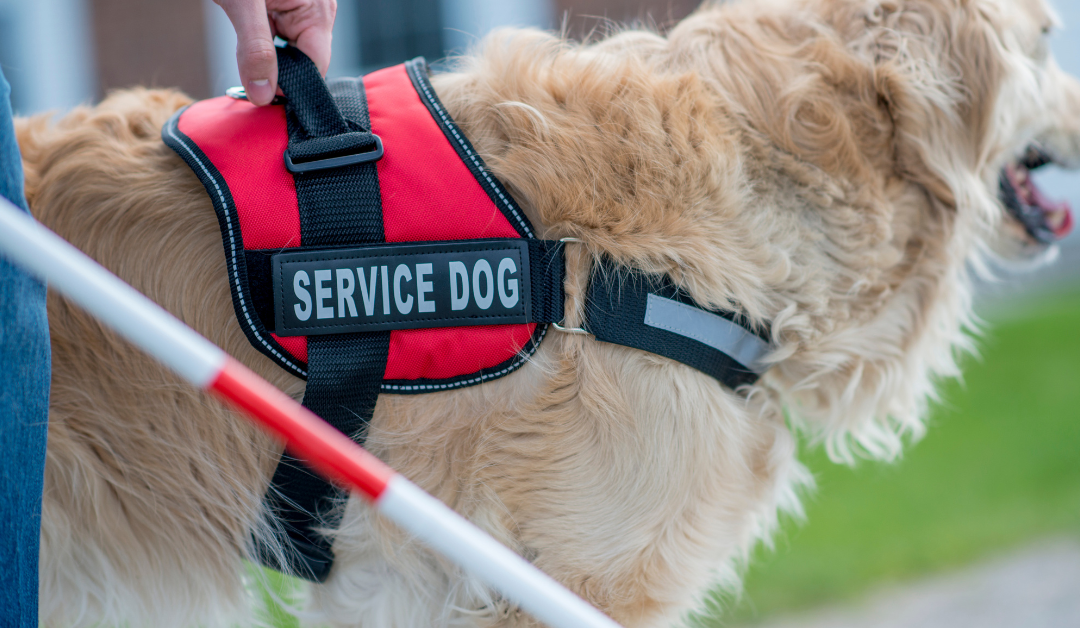
No — vests and ID cards are not legally required. They can help reduce challenges in public, but no business can require them.
Can my Florida landlord ask to see my PSD’s training records?
No — under the ADA and FHA, landlords cannot demand proof of training. They may only request a PSD letter confirming your disability-related need.
Is an emotional support animal the same as a psychiatric service dog in Florida?
No — ESAs provide comfort through presence and have housing protections only, documented with a Florida ESA letter. PSDs are task-trained and have full ADA public access rights.
What if a Florida business tells me PSDs aren’t allowed?
That’s a violation of the ADA. You can report it to the U.S. Department of Justice Civil Rights Division or the Florida Commission on Human Relations.
Can I use a PSD for both PTSD and anxiety?
Yes — a PSD can be trained for multiple tasks across different symptoms of the same or related conditions.
Can I train my existing pet dog to be a PSD in Florida?
Yes — Florida and federal law allow owner-training. Your dog just needs to successfully perform its disability-related task.