
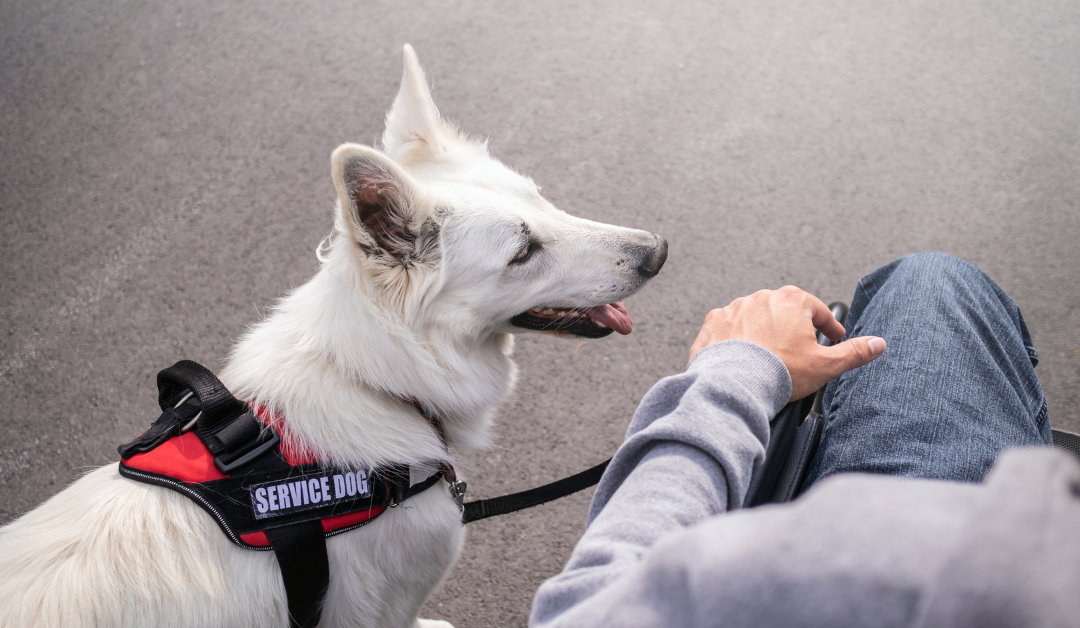
Arizona’s population has grown rapidly over the past decade — and so has awareness around mental health. The state’s high temperatures, transient communities, and sprawling urban centers create unique stressors that can worsen conditions like anxiety, PTSD, and depression. For residents managing these challenges, understanding how to get a psychiatric service dog in Arizona can open doors to a level of daily independence and stability that medication and therapy alone sometimes cannot provide. This guide covers the full 2026 process — from Arizona-specific law to training options, realistic costs, and the practical steps to get started.
Arizona’s Legal Framework for Psychiatric Service Dogs
Arizona’s service animal law is defined under Arizona Revised Statutes § 11-1024, which aligns closely with the federal ADA. As of 2025 amendments, the statute explicitly includes psychiatric disabilities among those protected.
What Arizona law guarantees in 2026:
- Any dog trained to perform tasks for a person with a physical, sensory, psychiatric, intellectual, or other mental disability qualifies as a service animal.
- Miniature horses are also recognized as service animals in Arizona — one of only a handful of states where this applies.
- Public accommodations cannot discriminate against handlers of service animals.
- Fraudulent misrepresentation of a pet as a service animal is a violation with civil penalties.
- License fees cannot be charged to individuals with disabilities for their service dogs.
Arizona does not maintain a state PSD registry. Vests, ID cards, and certification papers are optional and carry no legal weight.
Qualifying Conditions for a PSD in Arizona
You must have a psychiatric disability that substantially limits a major life activity under the ADA. The Arizona Department of Administration’s guidance mirrors this standard.
Common qualifying conditions in 2026 include:
- PTSD (especially common among Phoenix-area veterans)
- Agoraphobia or severe panic disorder
- Major depression with functional impairment
- Bipolar disorder with mood dysregulation
- Dissociative disorders
- Schizophrenia spectrum disorders
One important note: simply having anxiety or sadness does not automatically qualify you. The condition must meaningfully disrupt how you live, work, or care for yourself. If you fall short of that threshold but still benefit from an animal’s companionship, Arizona ESA laws cover the housing protections available through the ESA route.
The Four Steps to Getting Your PSD in Arizona
Step 1: Book a Mental Health Evaluation
You need to speak with a licensed mental health professional (LMHP) who is licensed to practice in Arizona. This includes psychologists, psychiatrists, licensed counselors (LPC), and licensed clinical social workers (LCSW).
In the evaluation, your provider will assess:
- Your diagnosis and symptom severity
- How your condition limits daily functioning
- Whether a psychiatric service dog is clinically appropriate
Arizona residents can access telehealth evaluations quickly through platforms like CheapESALetter, which connects users with in-state-licensed providers. This is often faster than waiting weeks for an in-person appointment.
Step 2: Receive Documentation
If you qualify, your provider issues a PSD letter. This is a signed document on professional letterhead confirming your diagnosis and the clinical need for a psychiatric service dog. It is not legally required for public access, but it is enormously practical.
For housing: your landlord in Scottsdale, Tucson, Mesa, or anywhere in Arizona cannot deny accommodation or charge pet fees for a task-trained PSD — with or without a letter. However, presenting one upfront prevents most disputes. Check the current documentation pricing at CheapESALetter to plan your budget.
Step 3: Select and Assess Your Dog
Arizona’s climate is worth considering when selecting your dog. Breeds with thick coats — like Siberian Huskies or Malamutes — often struggle in Phoenix’s summer heat. Labrador Retrievers, Golden Retrievers, Standard Poodles, and German Shepherds tend to adapt better.
Beyond breed, assess your dog for:
- Trainability — does the dog respond well to positive reinforcement?
- Public composure — does the dog remain calm around strangers, traffic, and loud environments?
- Bond with handler — can the dog detect subtle shifts in your emotional or physiological state?
Step 4: Train Your Dog for Specific Psychiatric Tasks
This step takes the most time — typically 6 to 24 months of consistent work. Under the ADA, you do not need a professional trainer. You can owner-train your dog as long as it reliably performs its task and is under your control in public.
Arizona-specific task training ideas based on common diagnoses:
For PTSD: Room-clearing behavior, nightmare interruption, creating a perimeter barrier in crowds
For anxiety/panic disorder: Deep pressure therapy (DPT), pawing to interrupt hyperventilation, guiding the handler to a quieter space
For bipolar disorder / OCD: Medication reminders via trained nudging, interrupting repetitive behaviors, alerting to escalating emotional cues
What a PSD Actually Costs in Arizona in 2026
Many people assume a psychiatric service dog is only accessible to the wealthy. That is not true if you owner-train.
| Path | Estimated Cost (2026) |
| Fully program-trained PSD | $15,000 – $30,000+ |
| Professional private trainer | $1,500 – $8,000 over several months |
| Structured online training course | $199 – $500 |
| Adopting a suitable dog | $50 – $2,500 depending on source |
| PSD letter from licensed LMHP | $100 – $200 |
Veterans in Arizona may qualify for free or subsidized service dogs through VA programs or nonprofits. Visit CheapESALetter’s blog for a breakdown of funding resources available to different groups.
PSD Access Rights Across Arizona’s Major Cities
Whether you live in Phoenix, Tucson, Tempe, Chandler, or a smaller community, Arizona law and the ADA apply uniformly. Your PSD must be admitted to:
- Grocery stores, restaurants, and retail locations
- Hotels and short-term rentals (under ADA, not FHA)
- Hospitals and medical offices
- Universities and community colleges
- Public transportation including buses and the Valley Metro Rail
No business may charge you an entry fee or ask for documentation beyond the two permitted questions.
ESA vs. PSD in Arizona: A Practical Breakdown
Arizona does not have additional state-level ESA protections beyond federal law. This is worth knowing. An ESA in Arizona provides housing protection under the FHA once you have a valid ESA letter in Arizona — but that is where its protections end. It cannot enter a restaurant, join you at a hotel, or fly in the cabin for free. A PSD has all of those rights. The difference is the task training requirement. If you’re close to the qualifying threshold and unsure which route suits you, schedule an appointment with a licensed provider to discuss your specific situation.
A Note on Arizona’s Fraud Laws
Arizona law takes misrepresentation of service animals seriously. Falsely claiming a pet is a service animal to gain public access is a civil violation under ARS § 11-1024, subject to fines. In 2026, enforcement has become more active, particularly in high-traffic areas like Sky Harbor International Airport and Phoenix-area shopping centers. Do not purchase a vest or ID card online and assume that makes your pet a PSD. A properly trained dog performing a genuine task is what matters legally — and practically.
Ready to Start?
You now know how to get a psychiatric service dog in Arizona — and in 2026, the process is more accessible than ever thanks to telehealth. Don’t let cost, confusion about laws, or uncertainty about training hold you back.
Start with your evaluation. Connect with CheapESALetter to speak with a licensed mental health professional today.
Frequently Asked Questions
Does Arizona require PSDs to be professionally trained?
No — the ADA allows owner-training, and Arizona law follows this standard, so you can train your own dog.
Can my PSD accompany me into a restaurant in Tucson?
Yes — Arizona law prohibits any public accommodation from denying access to a person with a trained psychiatric service dog.
What two questions can a business legally ask about my PSD in Arizona?
They may only ask whether it is a service animal and what task it is trained to perform — nothing else is legally permitted.
Does Arizona recognize miniature horses as service animals?
Yes — Arizona is one of the few states that explicitly includes miniature horses in its service animal definition under ARS § 11-1024.
Is a PSD letter the same as an ESA letter in Arizona?
No — a PSD letter recommends a task-trained service dog and is useful for housing and travel, while an ESA letter applies only to emotional support animals with housing-only protections.